A physicist quotes a 5,000-year-old scripture the moment he detonates the first atomic bomb. That’s not a coincidence anyone should shrug off. This is the case for and against the idea that the Brahmastra nuclear weapon wasn’t a metaphor at all.
I want to start with a story you probably already know part of, because it’s the reason this theory refuses to die.
On July 16, 1945, in the New Mexico desert, J. Robert Oppenheimer watched the world’s first nuclear detonation and, in that instant, didn’t reach for a scientific term. He reached for a line from the Bhagavad Gita: “Now I am become Death, the destroyer of worlds.” Years later, when a journalist asked him bluntly whether Trinity was truly the first atomic detonation in human history, Oppenheimer gave an answer that was strange for a man who dealt only in facts: “Yes, in modern times.”
That single sentence is the crack that an entire theory has grown through. What if it wasn’t the first — in all of human history? What if the Mahabharata, written down millennia before the Manhattan Project, is quietly describing a Brahmastra nuclear weapon in language its own authors didn’t have the vocabulary to name?
This isn’t a peer-reviewed physics paper. It’s a theory — a compelling, unsettling, deeply researched piece of speculative history that lives at the crossroads of mythology, archaeology, and nuclear science. I’m going to walk you through the entire case, point by point, the way it was built. Where the evidence is shaky, I’ll say so. Where it’s genuinely eerie, I’ll let it sit there and be eerie.
What we’re covering
- The Trinity Test and the Brahmastra Nuclear Weapon Theory
- Kurukshetra’s Body Count: Proof of a Brahmastra Nuclear Weapon?
- The Human Fuel Behind an Ancient Nuclear Weapon
- Beyond One Bomb: Ancient India’s Celestial Arsenal
- Anatomy of the Brahmastra Nuclear Weapon
- Blast Radius of the Brahmastra Nuclear Weapon
- Ancient Symptoms, Modern Radiation Sickness
- The Protocol of Doom
- Mohenjo-Daro and the Search for a Blast Site
- The Silurian Hypothesis
- History on Repeat: The Stone Age Reset
- The Real Battlefield
- A Warning, or a Memory?
The Trinity Test and the Brahmastra Nuclear Weapon Theory
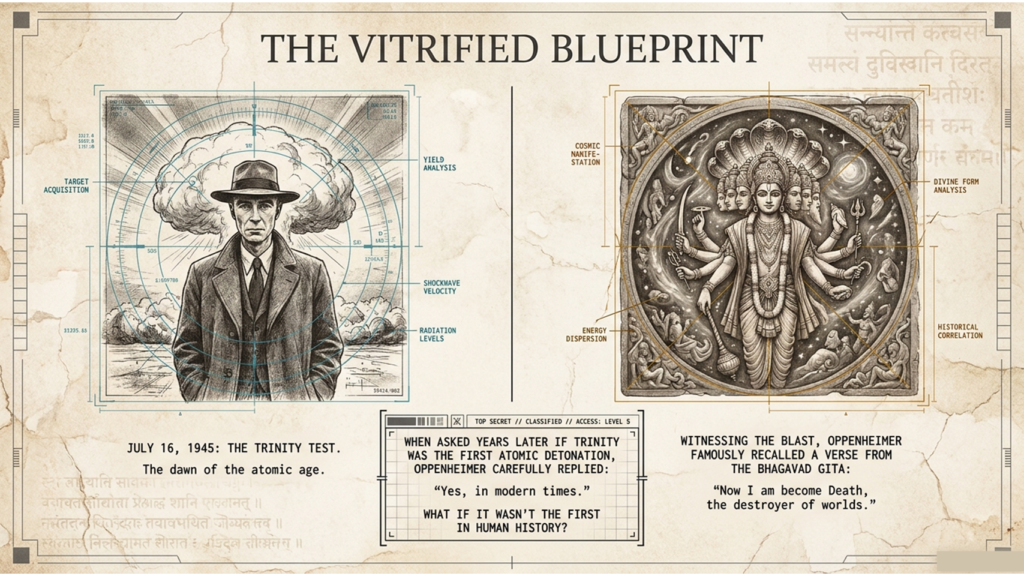
Here’s why Oppenheimer’s line matters so much to this theory. He wasn’t being poetic for the cameras. He was a man fluent in Sanskrit who had spent years studying the Gita, and the line he chose to recall wasn’t about fire or destruction in the abstract — it was Krishna revealing his terrifying, world-ending true form to Arjuna on a battlefield. Oppenheimer looked at the first nuclear detonation in modern history and it reminded him of a specific scene in a specific ancient war.
That’s the seed. Everything that follows is an attempt to answer one question: what if the resemblance isn’t a metaphor Oppenheimer projected onto the past, but a memory the past actually left behind? What if the Brahmastra nuclear weapon theory isn’t really a theory at all, but a plain reading of a text nobody wanted to take literally?
Kurukshetra’s Body Count: Proof of a Brahmastra Nuclear Weapon?
Before you get to any weapon, the math of the Kurukshetra war itself is where this theory starts building its case — and the numbers are genuinely strange.
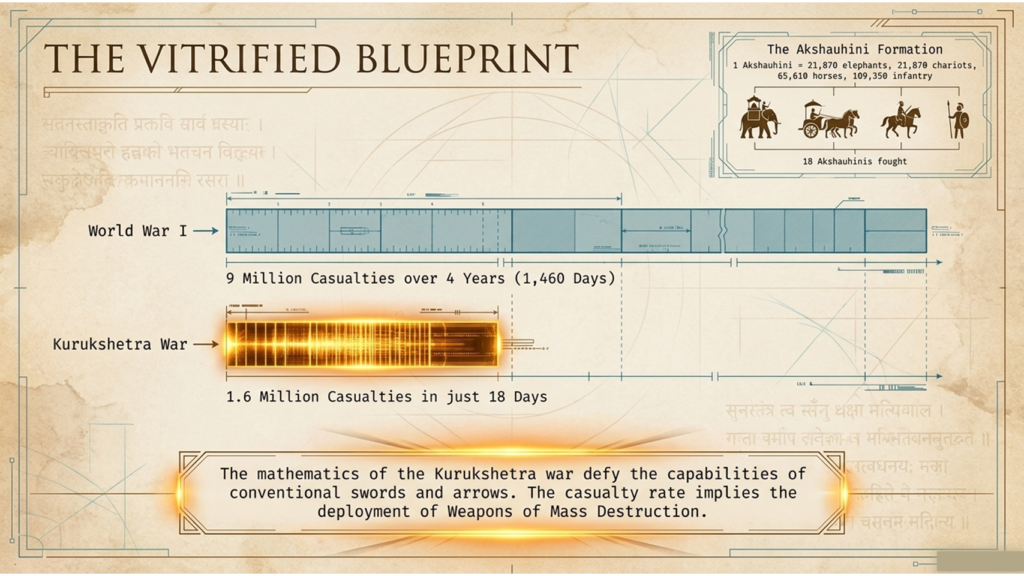
The Mahabharata measures armies in units called Akshauhini. One Akshauhini works out to roughly 21,870 elephants, 21,870 chariots, 65,610 horses, and 109,350 infantry. Eighteen full Akshauhini were said to have fought at Kurukshetra. Scale that up, and the war’s own text claims somewhere near 9 million casualties over 4 years of buildup and conflict — with roughly 1.6 million of those deaths happening in just the final 18 days of open battle.
Sit with that ratio for a second. However you feel about the literal numbers, the theory’s central argument is this: that kind of casualty rate, concentrated into eighteen days, doesn’t line up with what swords, arrows, maces, and war elephants can physically achieve. It’s the kind of number you’d expect from mechanized 20th-century warfare — or from a Brahmastra nuclear weapon being deployed at some point during those final days.
The Human Fuel Behind an Ancient Nuclear Weapon
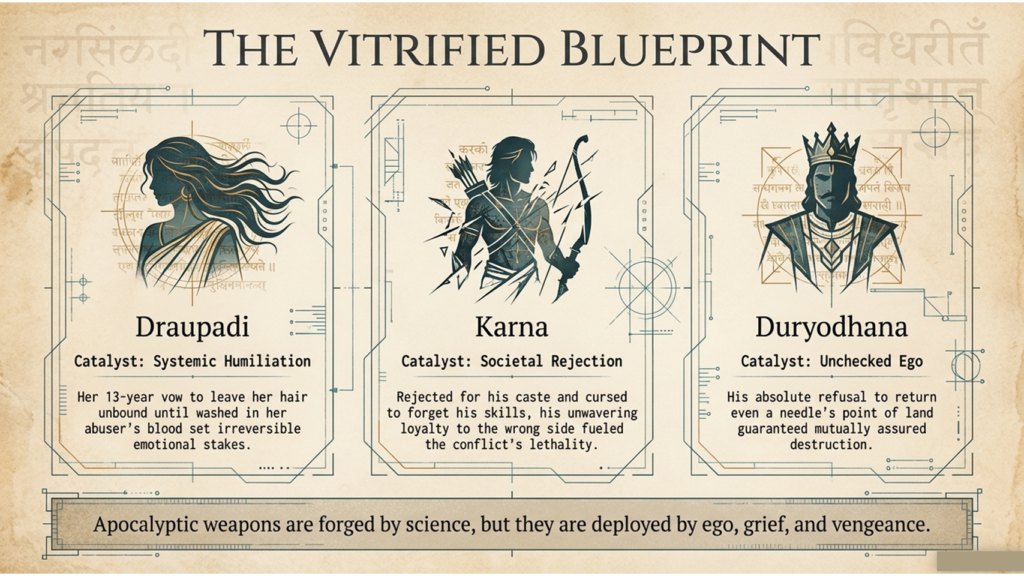
What keeps this theory from feeling like a cold physics exercise is that the epic never treats its weapons as the real story. The real story is always the people angry enough to use them.
Draupadi’s thirteen-year vow to leave her hair unbound until it’s washed in the blood of the man who humiliated her sets emotional stakes that can’t be walked back. Karna, rejected for his caste and cursed to forget his own skills at the exact moment he needs them most, pours his unwavering loyalty into the side that will eventually destroy him. And Duryodhana’s refusal to cede even “a needle’s point of land” guarantees something that sounds almost modern: mutually assured destruction, driven by ego rather than strategy.
The theory’s point here is simple and, frankly, hard to argue with: apocalyptic weapons are forged by science, but they are deployed by grief, humiliation, and unchecked ego. A Brahmastra nuclear weapon doesn’t fire itself. Someone furious enough has to choose to use it.
Beyond One Bomb: Ancient India’s Celestial Arsenal
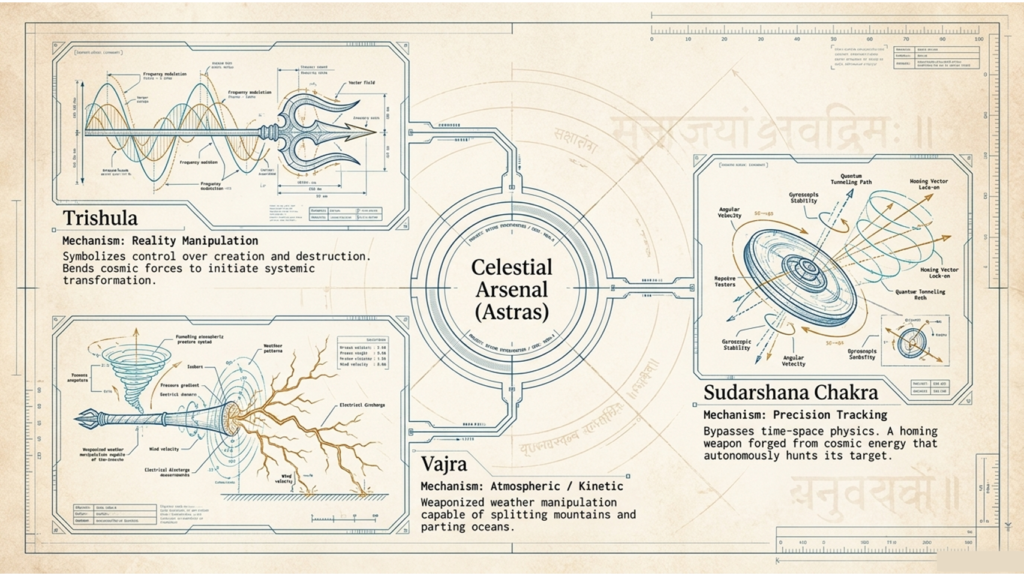
Before you even get to the Brahmastra nuclear weapon itself, the Mahabharata and surrounding texts describe an entire arsenal of astras, each with a strangely specific “mechanism”:
Trishula
Described as a tool of reality manipulation — control over creation and destruction, said to bend cosmic forces to initiate systemic transformation.
Sudarshana Chakra
A precision-tracking weapon that bypasses conventional time-space physics — a homing weapon forged from cosmic energy that autonomously hunts its target.
Vajra
An atmospheric and kinetic weapon — weaponized weather manipulation capable of splitting mountains and parting oceans.
Read individually, these sound like myth. Read as a weapons catalogue with the Brahmastra nuclear weapon sitting at the top of it as the last-resort option, the pattern is harder to dismiss as random poetic flourish.
Anatomy of the Brahmastra Nuclear Weapon
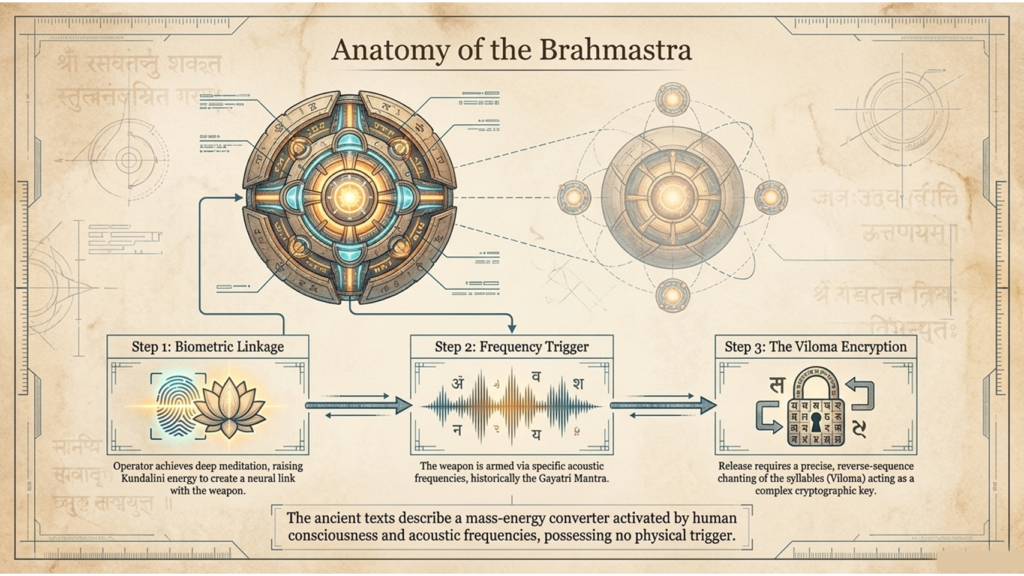
This is where the theory gets genuinely specific, and specificity is exactly what makes it compelling to people who’d otherwise dismiss it outright.
According to the ancient texts, arming a Brahmastra nuclear weapon required the operator to first achieve deep meditation, raising what’s described as Kundalini energy to form a neural link with the weapon itself. From there, it’s armed through specific acoustic frequencies — historically identified with the Gayatri Mantra. Releasing it required a precise, reverse-sequence chanting of syllables, called Viloma, functioning essentially as a cryptographic key.
Strip away the spiritual language and what you’re left with is a description of a mass-energy converter activated by human consciousness and acoustic frequency, with no physical trigger at all. Whether or not you buy the nuclear framing, that’s a startlingly modern way to describe a weapon in a text this old.
Blast Radius of the Brahmastra Nuclear Weapon
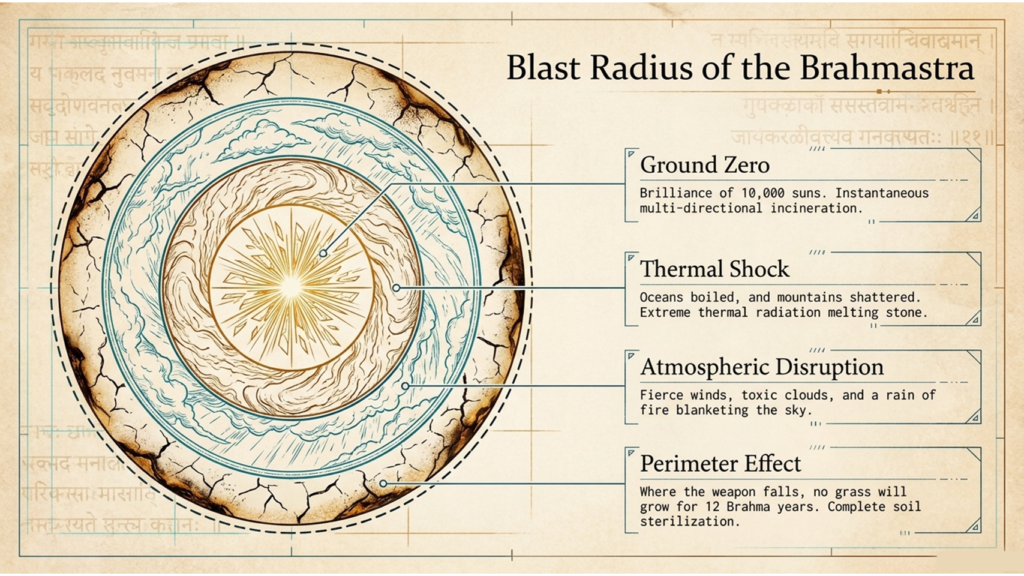
If you map the epic’s own description of the weapon’s effects onto a blast radius, four distinct zones emerge:
| Zone | Described effect |
|---|---|
| Ground Zero | Brilliance of 10,000 suns; instantaneous, multi-directional incineration |
| Thermal Shock | Oceans boiled and mountains shattered; extreme thermal radiation strong enough to melt stone |
| Atmospheric Disruption | Fierce winds, toxic clouds, and a rain of fire blanketing the sky |
| Perimeter Effect | No grass would grow for 12 Brahma years where the weapon fell — complete soil sterilization |
That last line is the one that keeps showing up in every version of this theory, because “nothing grows here for a generation” is functionally a plain-language description of radioactive fallout rendering land infertile — written by people who had no concept of radioactivity as we understand it.
Ancient Symptoms, Modern Radiation Sickness
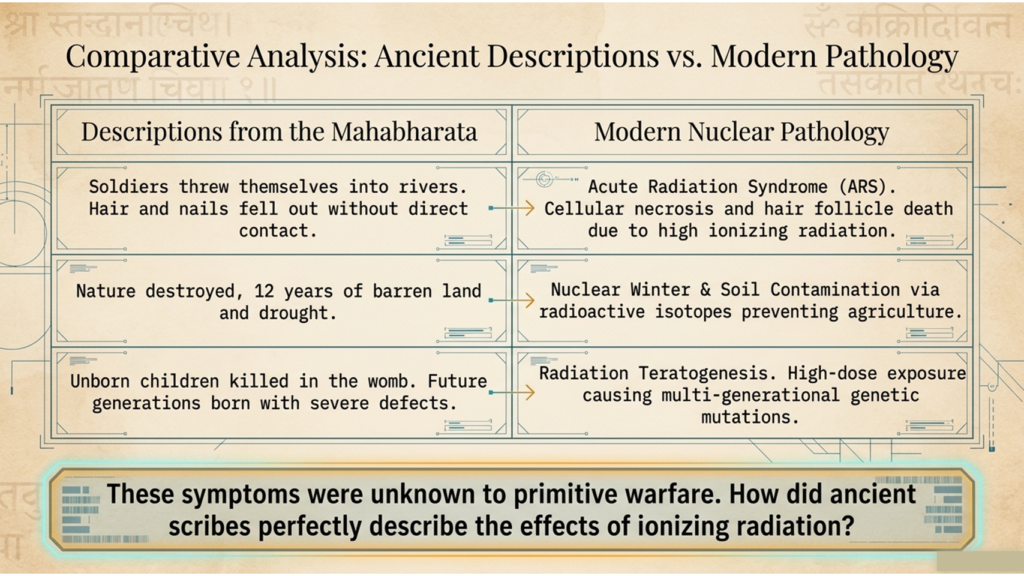
This comparison table is, honestly, the part of the deck that makes people go quiet:
| Description from the Mahabharata | Modern nuclear pathology |
|---|---|
| Soldiers threw themselves into rivers; hair and nails fell out without direct contact | Acute Radiation Syndrome (ARS) — cellular necrosis and hair follicle death from high ionizing radiation |
| Nature destroyed; 12 years of barren land and drought | Nuclear winter and soil contamination via radioactive isotopes, preventing agriculture |
| Unborn children killed in the womb; future generations born with severe defects | Radiation teratogenesis — high-dose exposure causing multi-generational genetic mutations |
The question the theory poses is a fair one to sit with, even if you stay skeptical: these symptoms were unknown to primitive warfare. So how did ancient scribes, with no framework for radiation at all, describe its effects this precisely — three separate times, in three separate ways?
The Protocol of Doom
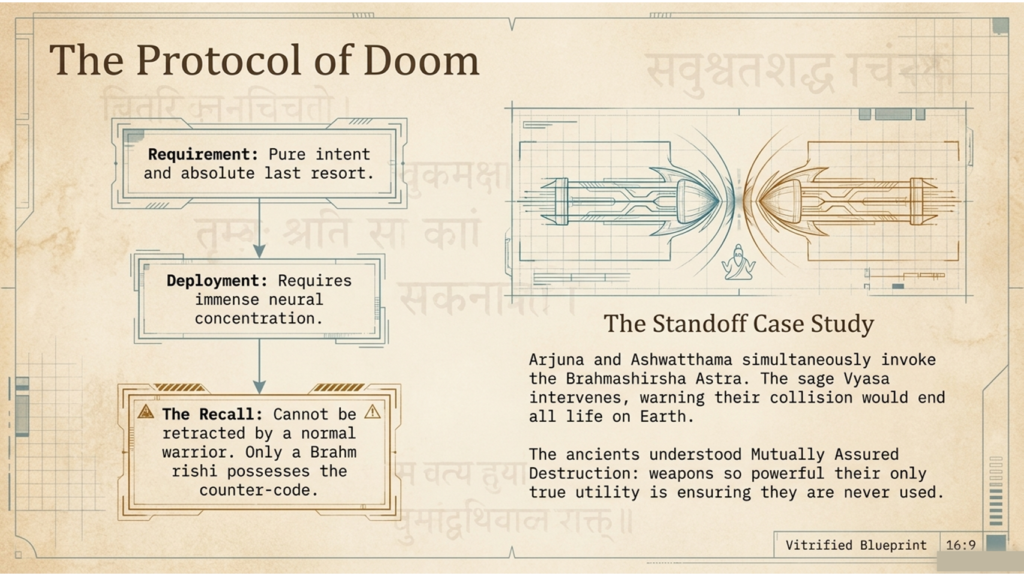
What’s most chilling about the Brahmastra nuclear weapon, according to the texts, isn’t how it’s fired. It’s how hard it is to stop.
The requirement for invoking it was pure intent and absolute last resort. Deployment demanded immense neural concentration. And the recall — the part that should terrify anyone thinking about this as a real weapon — could not be performed by a normal warrior at all. Only a Brahmarishi, a sage of the highest order, possessed the counter-code to safely withdraw it.
The clearest proof of how seriously the ancients treated this is the standoff between Arjuna and Ashwatthama, who simultaneously invoke the Brahmashirsha Astra — an escalated form of the Brahmastra nuclear weapon — against each other. The sage Vyasa physically intervenes, warning that if the two weapons collide, it would end all life on Earth. That’s not a battlefield anecdote. That’s a description of mutually assured destruction, written down as doctrine, thousands of years before the Cold War gave it a name. The ancients understood a weapon so powerful that its only real utility is ensuring it’s never used.
Mohenjo-Daro and the Search for a Brahmastra Nuclear Weapon Blast Site
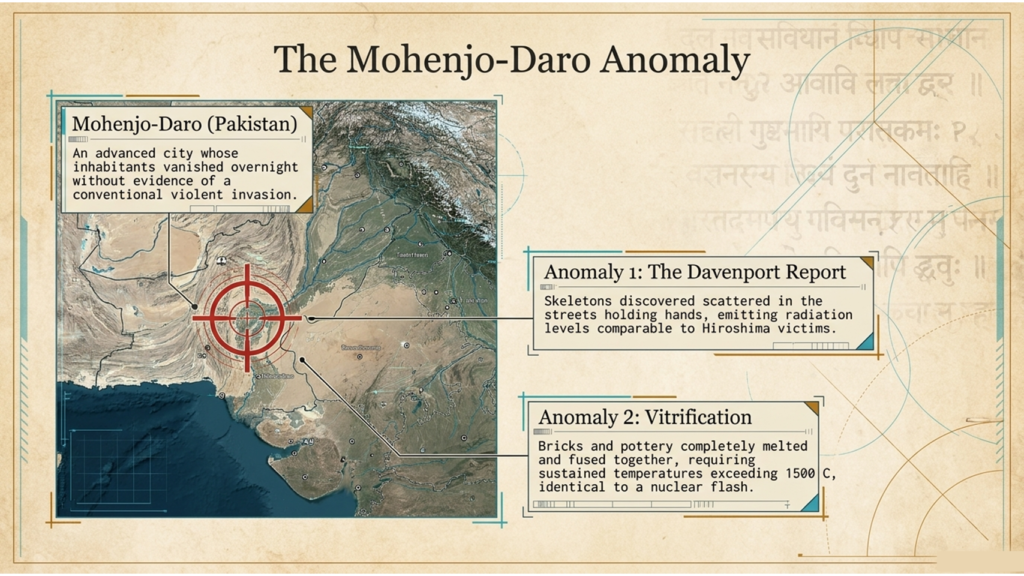

This is where the theory leaves scripture and tries to plant a flag in the physical world — and it’s also where you should read the most carefully.
Mohenjo-Daro, the real and extensively studied Indus Valley city in modern-day Pakistan, is an advanced ancient city whose population appears to have declined and eventually vanished without clear evidence of a conventional violent invasion. The theory attaches two specific claims to this: skeletons discovered scattered in the streets, some holding hands, said to show radiation levels comparable to Hiroshima victims (often referred to online as “the Davenport report”); and bricks and pottery at the site that appear fused together, said to require sustained temperatures exceeding 1,500°C — comparable to a nuclear flash.
A necessary pause here: the “Davenport report” and its radiation claims are widely circulated online but have never been verified in any peer-reviewed archaeological or radiological source, and mainstream Indus Valley scholarship attributes Mohenjo-Daro’s decline to far more mundane causes — river shifts, climate change, and gradual abandonment. The vitrified-brick claim is real in the sense that some fused material has been reported at sites in the region, but high-temperature fusion of ancient masonry has multiple well-documented non-nuclear causes, including kiln processes and later fires. This part of the Brahmastra nuclear weapon theory sits firmly in the territory of internet legend rather than established fact — fascinating to think about, but not something to take at face value.
The Silurian Hypothesis
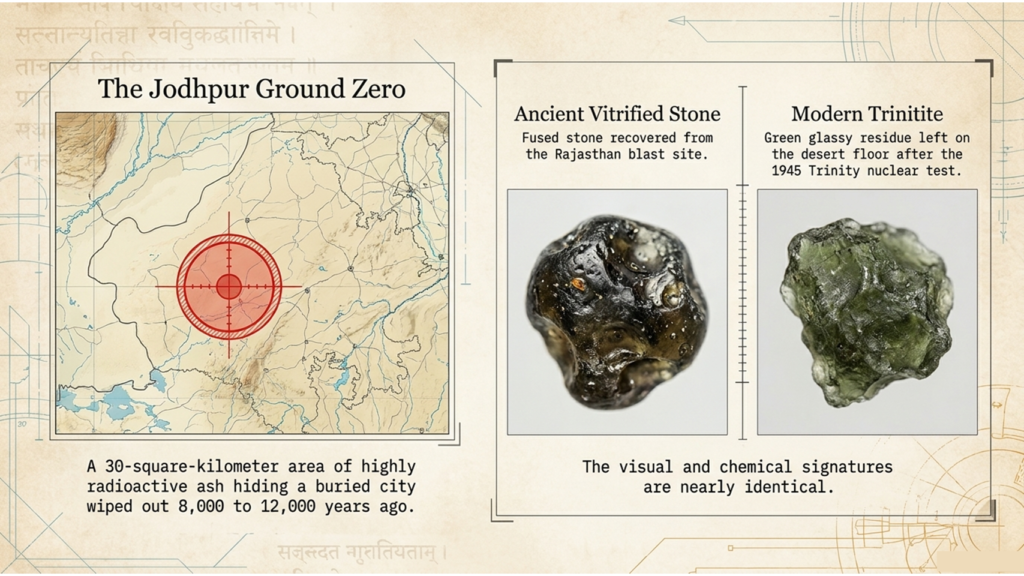
The most scientifically-grounded plank in this entire theory is also its most misused, so it deserves a careful explanation.
In 2018, astrophysicists Adam Frank and Gavin Schmidt published a genuinely real, peer-reviewed thought experiment called the Silurian Hypothesis. Their question: if an advanced industrial civilization had existed on Earth millions of years before humans, and later collapsed, what physical evidence would actually survive today? Their answer was that almost nothing would — most physical artifacts would eventually be crushed by tectonic activity — except for faint geological fingerprints, like sudden spikes in carbon cycles or unusual concentrations of radioactive isotopes in the rock record.
The theory around the Brahmastra nuclear weapon borrows this framework and applies it locally: it points to a roughly 30-square-kilometer area of highly radioactive ash in Rajasthan, said to be hiding a buried city destroyed somewhere between 8,000 and 12,000 years ago, and compares fused stone recovered from that site to Trinitite — the actual green glassy residue left behind on the New Mexico desert floor after the 1945 Trinity test. The visual similarity between the two materials is genuinely striking in photographs.
Here’s the important distinction: Frank and Schmidt’s actual paper is a methodological exercise about detecting hypothetical deep-time civilizations in geological data — it does not claim to have found evidence of an ancient Indian civilization, and the pair have never endorsed the “ancient nuclear war” reading of their work. Applying their framework to claim proof of a Brahmastra nuclear weapon is a leap the original scientists didn’t make. It’s an intriguing borrowed lens, not a confirmed finding.
History on Repeat: The Stone Age Reset
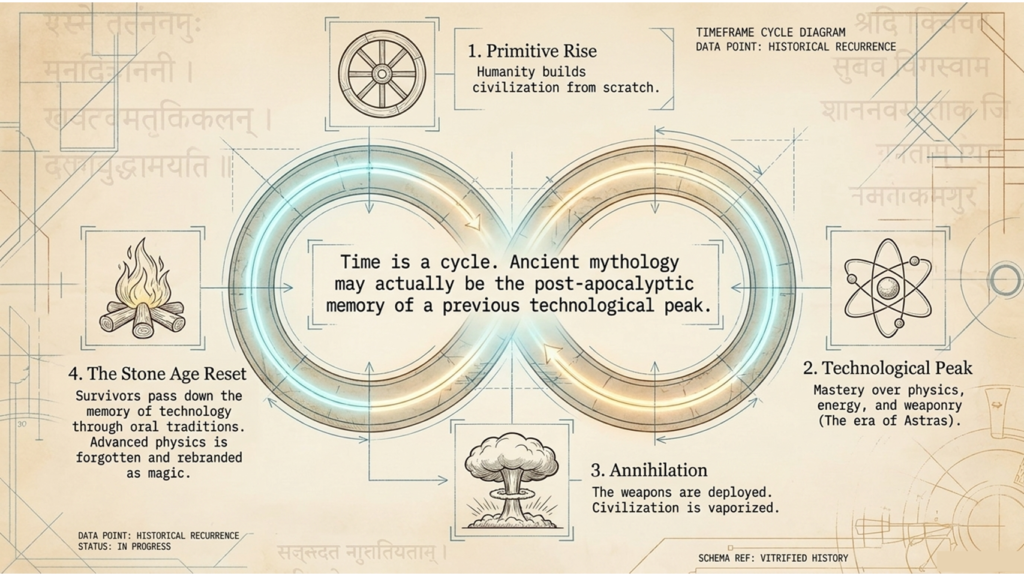
The theory’s final speculative leap is also its most philosophically interesting one: what if time itself is cyclical, and mythology is actually the post-apocalyptic memory of a previous technological peak?
The proposed cycle runs in four stages: humanity builds civilization from nothing (Primitive Rise); it masters physics, energy, and weaponry — “the era of Astras” (Technological Peak); the weapons are deployed and civilization is vaporized (Annihilation); and finally, survivors pass down fragments of what they remember through oral tradition, where advanced physics slowly gets forgotten and rebranded as magic (Stone Age Reset). If a Brahmastra nuclear weapon really was deployed at the end of one of these cycles, the theory argues, this is exactly the shape the aftermath would take — technology surviving only as scripture.
The Real Battlefield
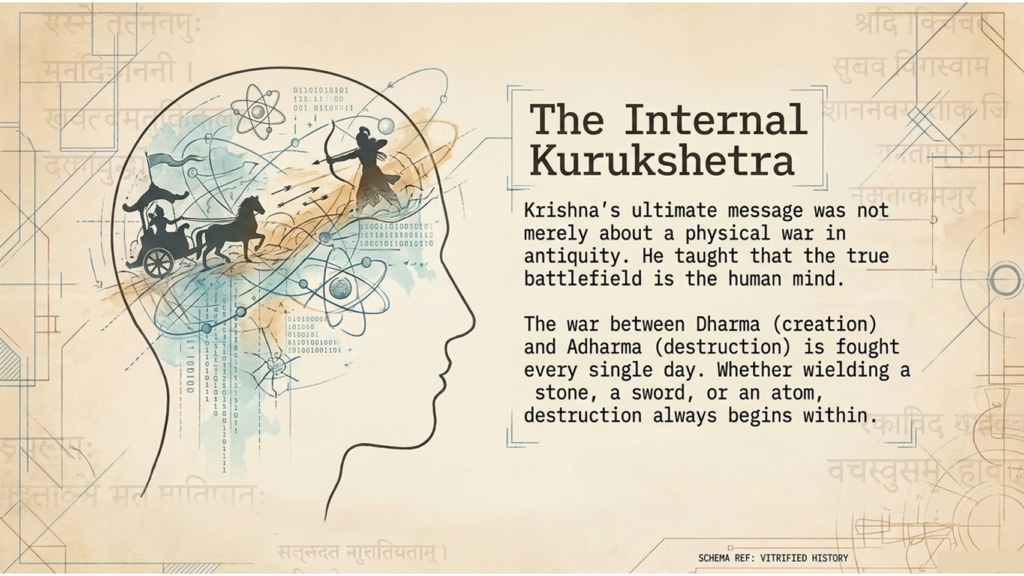
Whatever you conclude about the physical evidence, this is the part of the theory I think matters most, and it’s the part that keeps the whole story from being just a doomsday curiosity.
Krishna’s ultimate message in the Gita was never really about a physical war fought with a Brahmastra nuclear weapon or any other weapon. His teaching was that the true battlefield is the human mind — that the war between Dharma, the force of creation, and Adharma, the force of destruction, is fought every single day, whether the weapon in someone’s hand is a stone, a sword, or an atom. Destruction, in this reading, always begins internally, long before it becomes external.
A Warning, or a Memory?
Here’s where I land on all of this, and I think it’s a fair place for a skeptical reader to land too: the archaeological claims in this theory — the Mohenjo-Daro skeletons, the exact framing of the Silurian Hypothesis — don’t hold up to scrutiny, and you should treat them as folklore, not fact. But the textual evidence is a genuinely different story. The specificity of the Brahmastra nuclear weapon’s described symptoms, its activation ritual, its recall protocol, and its blast effects is hard to wave away as coincidence, even if you’re not ready to call it proof.
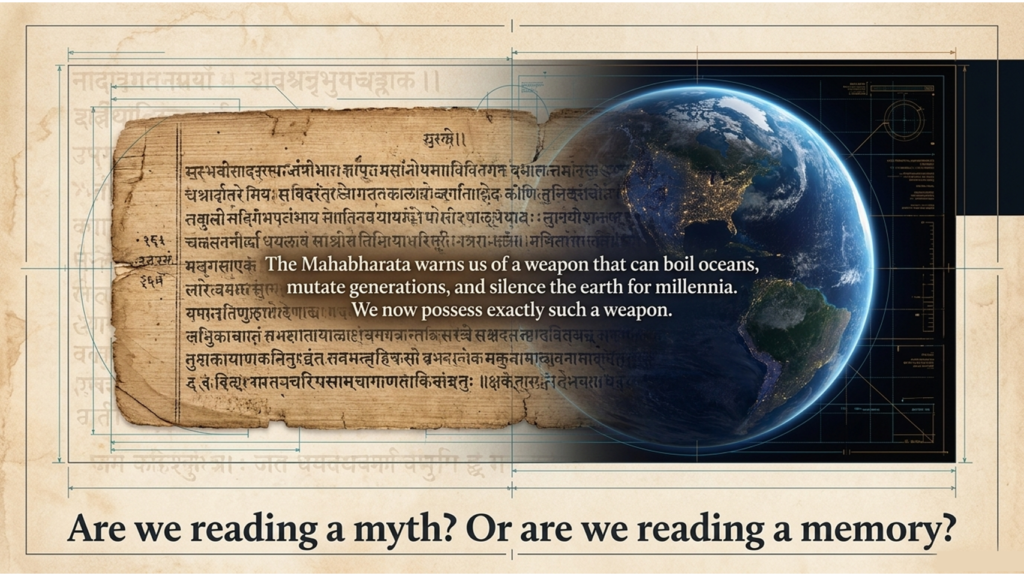
The Mahabharata warns us of a weapon that can boil oceans, mutate generations, and silence the earth for millennia. We now possess such a weapon.
Whatever the Brahmastra nuclear weapon actually was three thousand years ago, we built our own version of it in the twentieth century — and we’re the ones who now have to decide what to do with it. Which leaves the question this theory was really always asking:
Are we reading a warning, or are we reading a memory?
1 thought on “The Brahmastra Nuclear Weapon: Is This Ancient India’s Doomsday Secret?”