“Ashwatthama Brahmastra: Mahabharata’s Nuclear Weapon Myth”. A son’s grief. A weapon of four heads. Twelve Brahma-years of drought. Long before “nuclear winter” had a name, the Mahabharata described one — and the man who caused it never found peace again.
Every retelling of the Mahabharata eventually arrives at the same terrible night: Ashwatthama, son of Guru Drona, creeping into a sleeping camp to finish what the war itself couldn’t. But the story doesn’t end with a massacre. It ends with a weapon so absolute that even its own creator couldn’t call it back — and a curse that turns a warrior into something that outlives the war, the dynasty, and the world that remembers it.
This is a slow walk through that story: the chain of broken rules that made it possible, the weapon itself, the science-fiction-grade description in the text, and the eerie parallels modern readers keep drawing to nuclear war. Along the way, we’ll look at why one 20th-century Hindi play argued the real weapon was never the Brahmastra at all.
In this article
- The Yuga Wheel — why Kurukshetra had to happen
- The Escalation Staircase — four broken rules
- Sauptika Parva — the night raid
- The Morality Matrix — was Ashwatthama justified?
- Weapon Spec Sheet — the Brahmashirastra
- The Boomerang Effect — a weapon with no undo button
- The Blast Radius of Adharma
- Anatomy of Eternal Suffering — the curse
- Ancient Text vs. Modern Tech
- The Archaeological Echo
- The Stock Metaphor of Blindness
- The Beastly Transformation
- Autonomous Divinities
- The Real Weapon of Mass Destruction
Ashwatthama Brahmastra: Mahabharata’s Nuclear Weapon Myth:
The Yuga Wheel: Why Kurukshetra Had to Happen
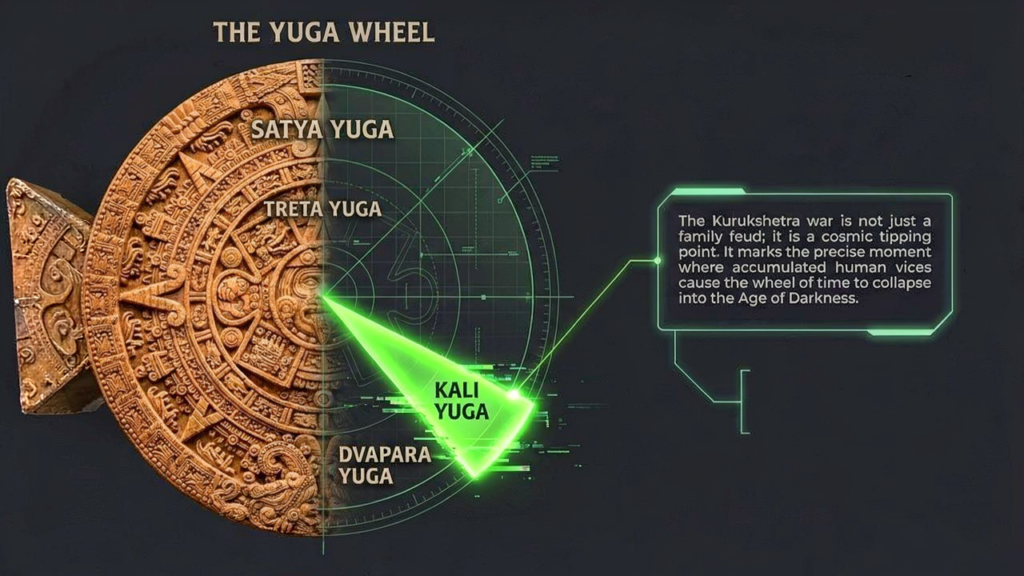
Kurukshetra is usually framed as a family dispute over a throne. Look at it on the scale of the yuga cycle, and it becomes something bigger: the exact hinge point where the wheel of time tips out of Dvapara Yuga and into Kali Yuga — the Age of Darkness.
The text is specific about the mechanism. It isn’t a single villain that ends an age. It’s accumulation — years of unchecked ambition and deceit compounding until the system itself gives way. Kurukshetra isn’t the cause of that collapse. It’s the moment the debt comes due.
The Escalation Staircase: Tit-for-Tat Adharma
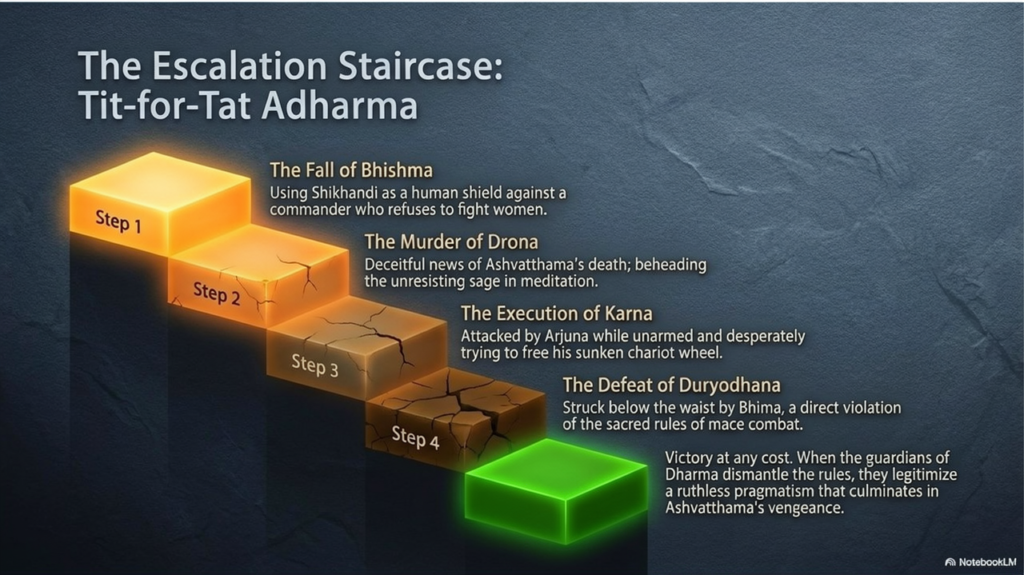
What makes the Ashwatthama story land as tragedy rather than simple villainy is the staircase that leads to it. Four times in eighteen days, the Pandavas’ side wins by breaking the very rules of dharmic warfare they claim to defend:
Step 1 — Bhishma
Shikhandi is placed in front of Arjuna as a human shield, exploiting Bhishma’s vow never to fight a warrior born a woman.
Step 2 — Drona
False news of Ashwatthama’s death is spread to break Drona’s resolve; he is beheaded while unarmed, seated in meditation.
Step 3 — Karna
Arjuna kills Karna while he is unarmed, struggling to free his chariot wheel from the mud.
Step 4 — Duryodhana
Bhima strikes him below the waist with a mace — a direct violation of the sacred rules of mace combat.
Each step is presented by the winning side as a necessary exception. Taken together, they make a quiet but devastating argument: when the guardians of dharma dismantle its rules for the sake of victory, they legitimize the very ruthlessness that eventually turns around and consumes them.
Sauptika Parva: The Night Raid
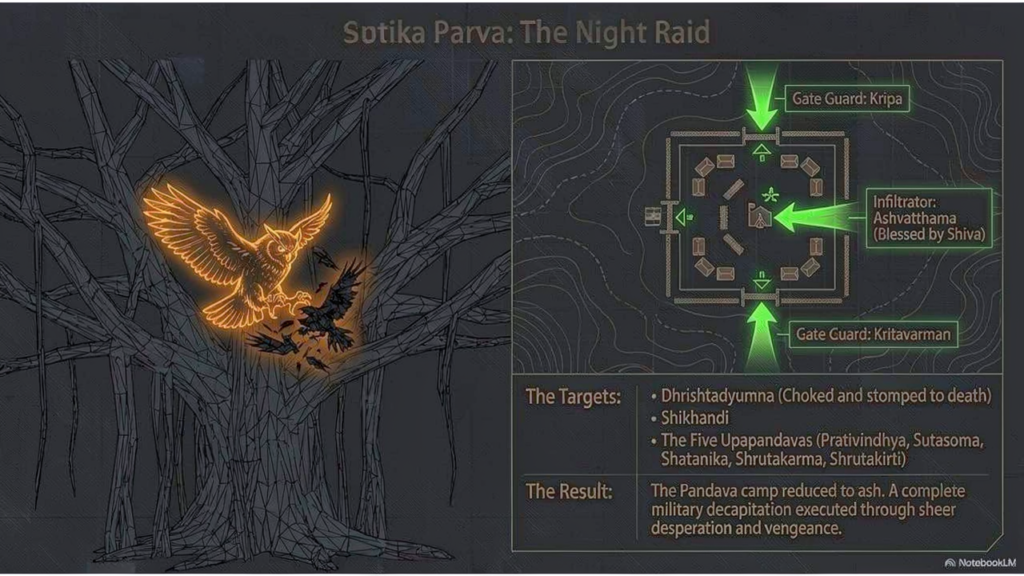
The Sauptika Parva — the “Book of the Sleeping Warriors” — opens with an omen: an owl, blessed and merciless, slaughtering crows roosting in a tree at night while they sleep. Vyasa uses it to foreshadow exactly what’s coming.
Blessed by Shiva himself, Ashwatthama slips past the gate guards Kripa and Kritavarman into the heart of the Pandava camp. His targets are not soldiers on a battlefield — they are Dhrishtadyumna, killed by strangulation and trampling; Shikhandi; and the five sons of the Pandavas, the Upapandavas, cut down as they slept. By dawn, the camp that survived eighteen days of open war is ash — a complete military decapitation achieved not through strength, but through desperation and vengeance operating outside every rule of war the epic has spent seventeen books establishing.
THE COMPLETE MAHABHARATA
KARNA PARVA SALYA PARVA SAUPTIKA PARVA STRI PARVA VOL 7
- About the Author – Born in 1951, S.B. Pillay (1951–2014) was a retired Indian Audit and Accounts Service officer. He was educated at St Xavier’s High School (Delhi), Loyola College (Kolkata) and received his master’s degree from Loyola College in Chennai. He went on to study Law at St Xavier’s College, Mumbai. During an illustrious career in the IA&AS, he worked all over India and abroad, as well and has a deep insight of Indian life. He was director general of the NAAA in Shimla and retired as additional deputy CAG in 2011. Anita Pillay is the wife of the late S.B. Pillay.
The Morality Matrix: Was Ashwatthama Justified?
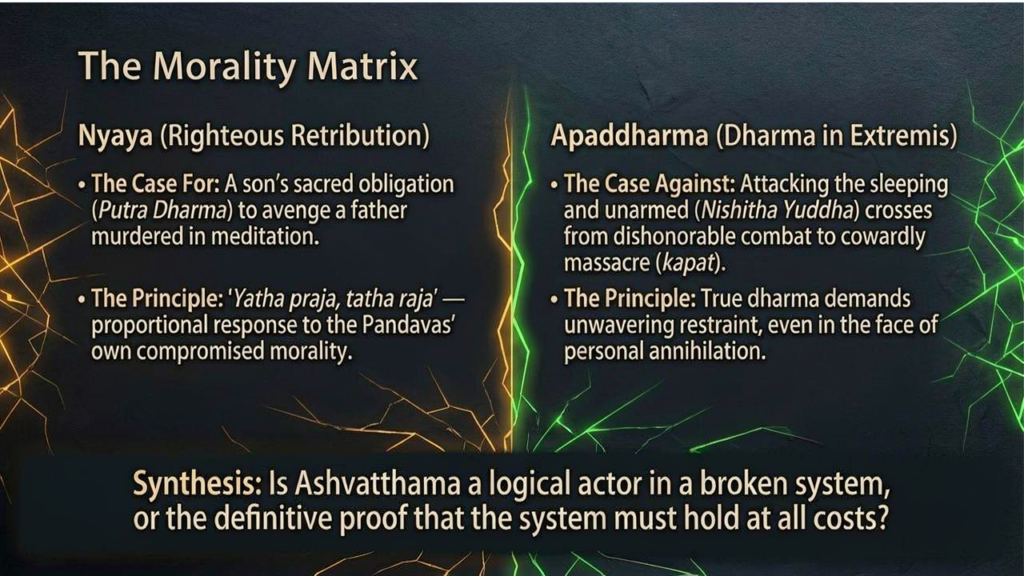
This is where the story stops being simple. Two dharmic arguments collide directly over the night raid:
| Nyaya — Righteous Retribution | Apaddharma — Dharma in Extremis |
|---|---|
| The case for: A son’s sacred obligation (Putra Dharma) to avenge a father murdered while defenseless in meditation. | The case against: Attacking the sleeping and unarmed (Nishitha Yuddha) crosses from dishonorable combat into cowardly massacre (kapat). |
| The principle: Yatha praja, tatha raja — a proportional response to the Pandavas’ own already-compromised conduct. | The principle: True dharma demands unwavering restraint, even facing personal annihilation. |
The synthesis question the epic leaves open: Is Ashwatthama a logical actor operating inside a system that had already broken its own rules four times over — or is he the definitive proof that the system must hold its principles at any cost, precisely because this is what happens when it doesn’t?
Weapon Spec Sheet: The Brahmashirastra
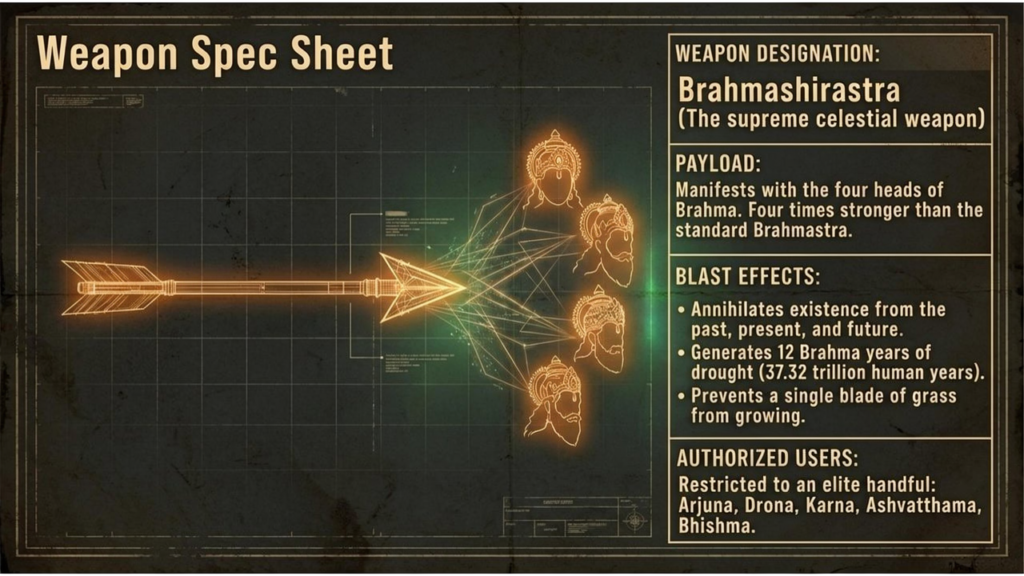
Cornered and out of options, Ashwatthama reaches for the deadliest weapon in his arsenal — one step beyond the standard Brahmastra.
| Designation | Brahmashirastra — the supreme celestial weapon |
|---|---|
| Payload | Manifests with the four heads of Brahma; four times more powerful than a standard Brahmastra |
| Blast effects | Annihilates existence across past, present and future; generates twelve Brahma-years of drought (37.32 trillion human years in the epic’s own reckoning); prevents even a blade of grass from growing |
| Authorized users | A handful of names: Arjuna, Drona, Karna, Ashwatthama, Bhishma |
It’s worth sitting with that restriction. The text treats this as a weapon so catastrophic that only a handful of the era’s greatest warriors were ever trusted — or able — to invoke it at all.
The Boomerang Effect: Mechanics of Invocation
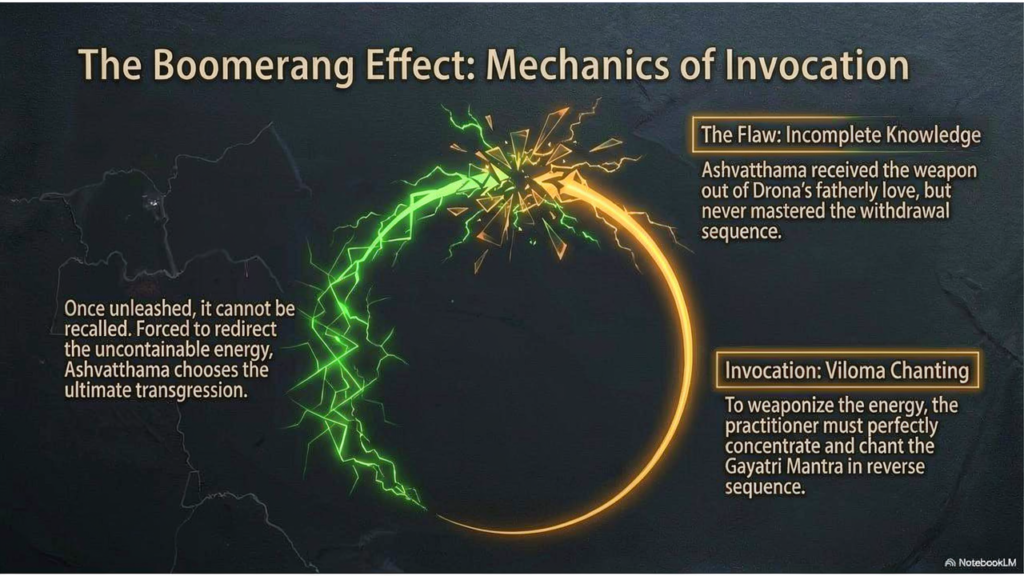
The most human detail in this entire episode is a technical one: Ashwatthama never finished his training. He received the weapon out of Drona’s fatherly love, in haste, and never mastered the viloma chant — reciting the Gayatri Mantra in reverse — required to safely withdraw it once invoked.
That single gap in his knowledge is the hinge the whole tragedy turns on. A weapon this powerful, once released, cannot be recalled. Forced to redirect uncontainable energy he no longer controls, Ashwatthama is pushed toward the one target guaranteed to absorb it completely — and chooses the ultimate transgression.
The Blast Radius of Adharma
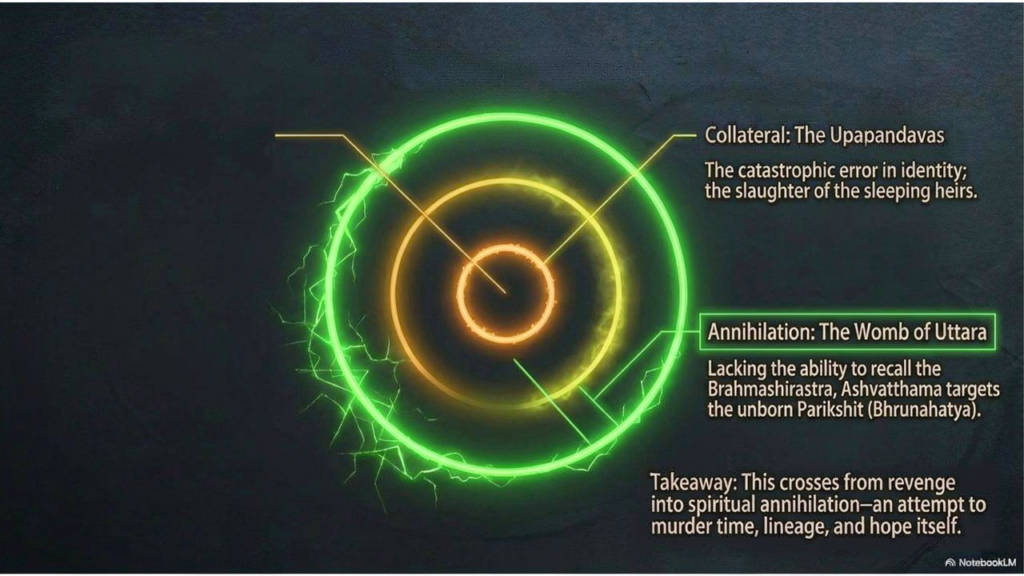
Traced outward, the strike has three distinct rings. At the center: Dhrishtadyumna, the immediate target of filial vengeance. The next ring: the Upapandavas, already dead by his sword — collateral damage born of a catastrophic error in identity, the slaughter of sleeping heirs mistaken in the dark. The outermost ring is the one that changes the story’s category entirely — unable to recall the weapon, Ashwatthama turns it on the unborn Parikshit in Uttara’s womb, an act the tradition names bhrunahatya.
That final ring is the line the epic uses to mark the crossing from revenge into something else — an attempt to murder not a person, but time, lineage, and hope itself.
Anatomy of Eternal Suffering
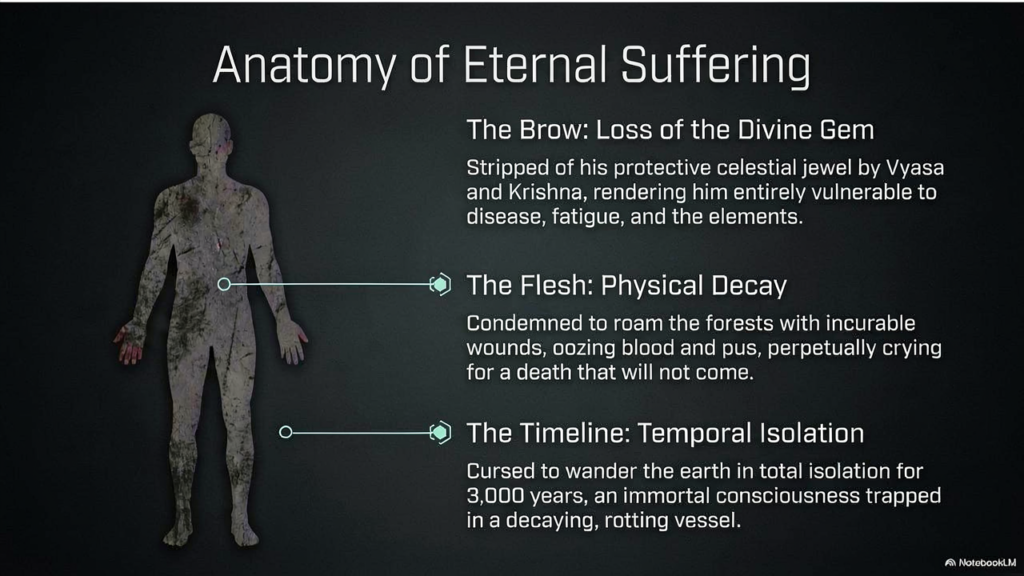
Krishna and Vyasa’s response is not execution — it’s something the text clearly considers worse. The curse lands in three places at once:
The Brow
Stripped of the protective celestial jewel embedded in his forehead, leaving him permanently vulnerable to disease, fatigue, and the elements.
The Flesh
Condemned to wander with incurable, festering wounds — perpetually seeking a death that will never come.
The Timeline
Cursed to isolation for 3,000 years: an immortal consciousness trapped inside a decaying, rotting vessel.
Death, in this story, would have been mercy. What Ashwatthama receives instead is a body that keeps failing without ever ending.
Ancient Text vs. Modern Tech
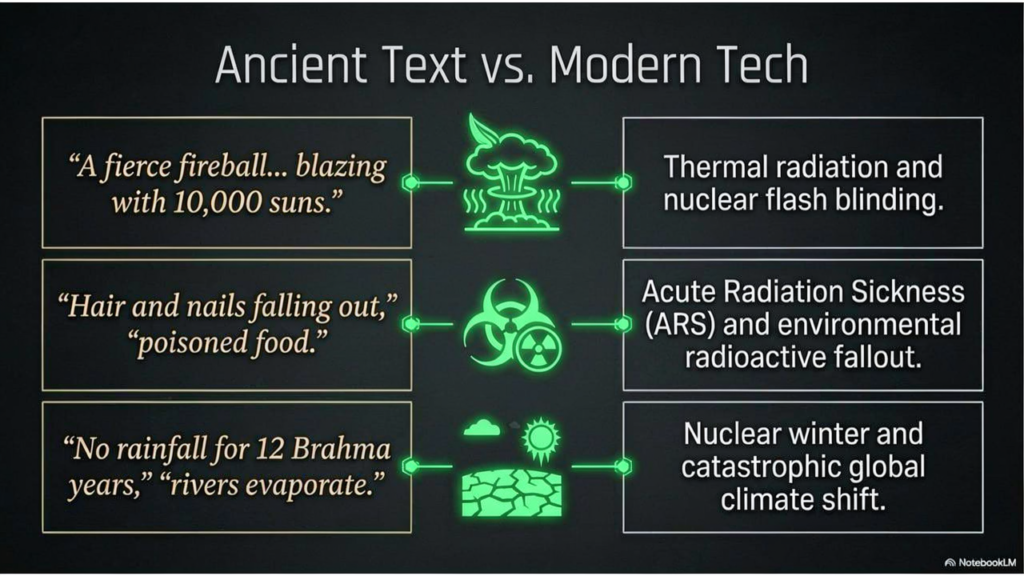
This is the part of the story that keeps modern readers awake. Set the epic’s own language beside 20th-century accounts of nuclear weapons, and the overlap is hard to wave away:
| The epic’s description | What it resembles |
|---|---|
| “A fierce fireball… blazing with 10,000 suns” | Thermal radiation and nuclear flash blinding |
| “Hair and nails falling out,” “poisoned food” | Acute Radiation Sickness and environmental radioactive fallout |
| “No rainfall for 12 Brahma years,” “rivers evaporate” | Nuclear winter and catastrophic global climate shift |
To be clear-eyed about it: this is a comparison people have drawn for decades, not a settled scientific claim, and the epic is a work of dharmic literature first. But the specificity of the symptoms described — hair loss, fetal harm, drought lasting a generation — is exactly why the comparison keeps resurfacing every time nuclear weapons enter public conversation.
The Archaeological Echo
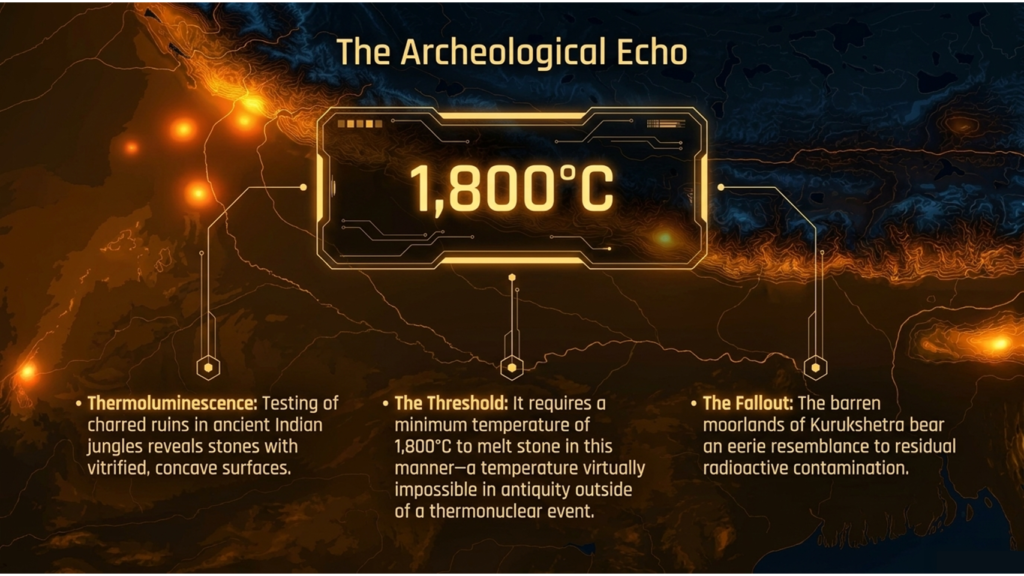
The strongest version of this theory usually leans on a claimed physical trace: thermoluminescence testing of charred ruins in ancient Indian jungles, said to reveal stones with vitrified, concave surfaces — glass-like melting that, on Earth, typically requires around 1,800°C to occur. That’s a threshold conventional fire in antiquity essentially cannot reach outside a thermonuclear-scale event. Believers point to the barren moorlands around Kurukshetra itself as an eerie visual echo of land scarred by radioactive contamination.
Worth flagging plainly: this claim circulates widely online but isn’t backed by peer-reviewed archaeological consensus, and vitrified stone has several well-documented non-nuclear causes (lightning strikes, volcanic activity, and deliberate ancient vitrification techniques among them). It belongs in this story as folklore-meets-pseudoscience — fascinating, but not established fact.
The Stock Metaphor of Blindness
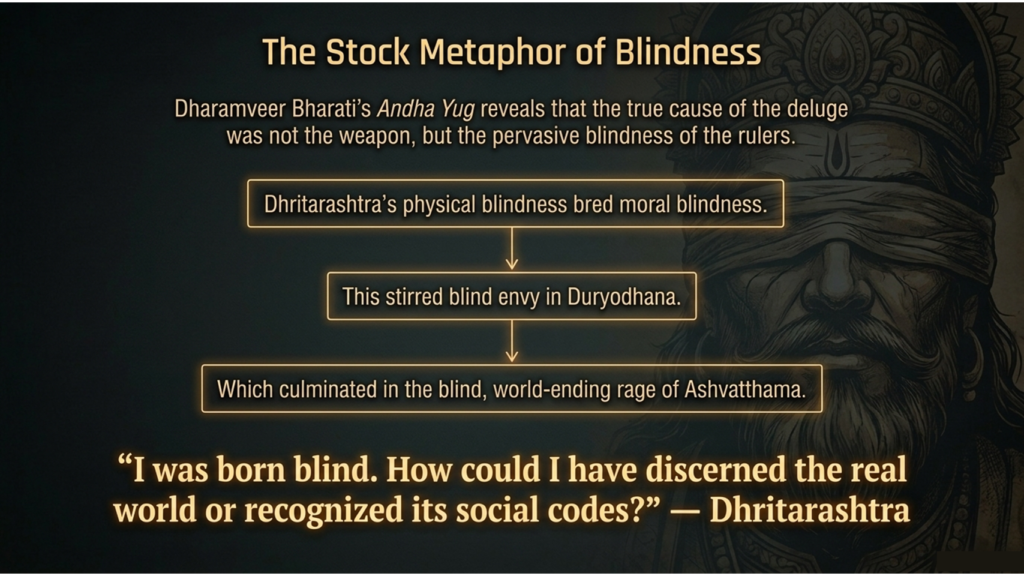
Dharamveer Bharati’s landmark Hindi verse-play Andha Yug (“The Blind Age”) reframes this entire chain of events around a single idea: the true cause of the deluge was never the weapon. It was blindness — moral, not just physical — passed down like an inheritance.
The play traces it as a straight line: Dhritarashtra’s physical blindness breeds a moral blindness that lets him indulge his son unchecked. That indulgence stirs blind envy in Duryodhana. And that envy, left to compound through eighteen days of war and four broken rules, culminates in the blind, world-ending rage of a grieving son with a weapon he can’t control.
The Beastly Transformation
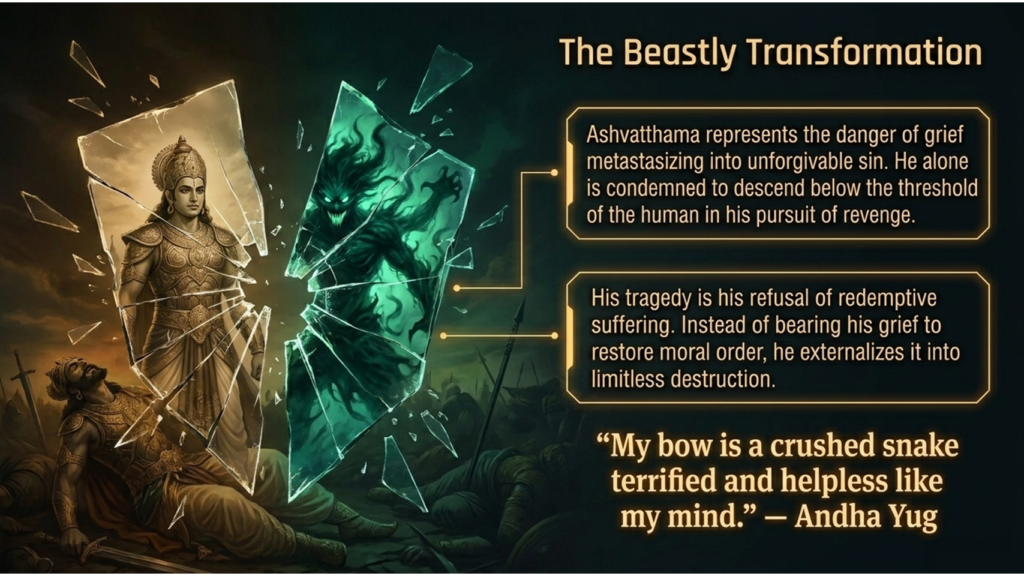
Strip away the weapon and the war, and what’s left is a much smaller, much more human story: grief that was never allowed to be grief. Ashwatthama represents the danger of loss metastasizing into something unforgivable — the one figure in the entire epic condemned to fall below the threshold of the human in pursuit of revenge.
His tragedy isn’t the curse. It’s the refusal that came before it — the refusal of redemptive suffering. Instead of carrying his grief in a way that could eventually restore moral order, he externalizes it into limitless destruction.
“My bow is a crushed snake, terrified and helpless like my mind.”— Andha Yug
Autonomous Divinities: Ancient Concepts, Modern Framing
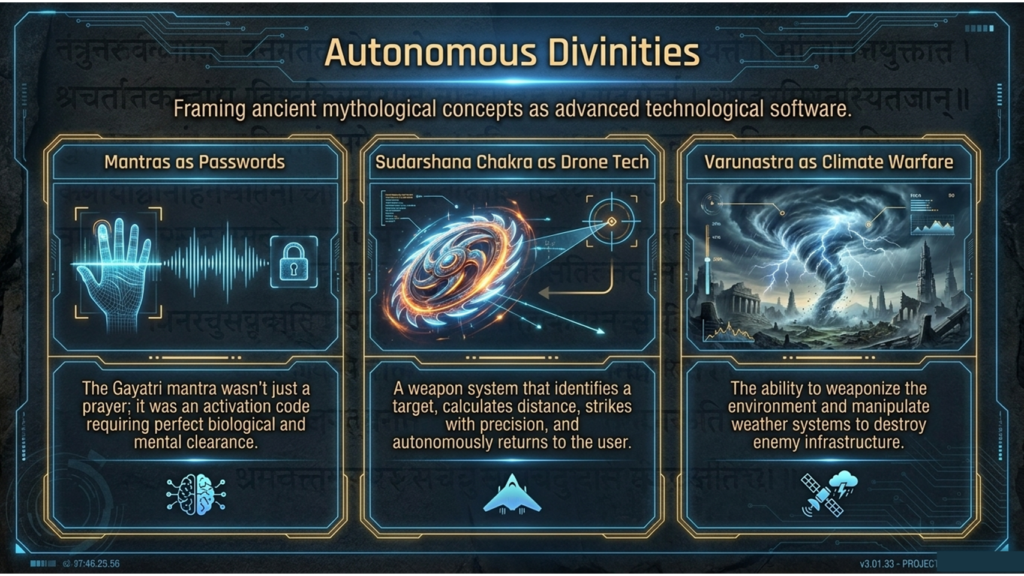
Part of why this story travels so well into modern conversation is how naturally its concepts map onto today’s technology vocabulary — whether or not that mapping is literal:
Mantras as Passwords
The Gayatri mantra functions less like a prayer here and more like an activation code — one requiring perfect biological and mental “clearance” to use correctly.
Sudarshana Chakra as Drone Tech
A weapon system that identifies a target, calculates distance, strikes with precision, and autonomously returns to its user.
Varunastra as Climate Warfare
The ability to weaponize environment itself — manipulating weather systems to destroy enemy infrastructure.
None of this is a claim that ancient India possessed literal drone fleets or password systems. It’s a way of reading the epic’s imagination on its own terms — as a text describing forces so far beyond ordinary human capability that its authors reached for the language of absolute, almost mechanical power to describe them.
The Real Weapon of Mass Destruction
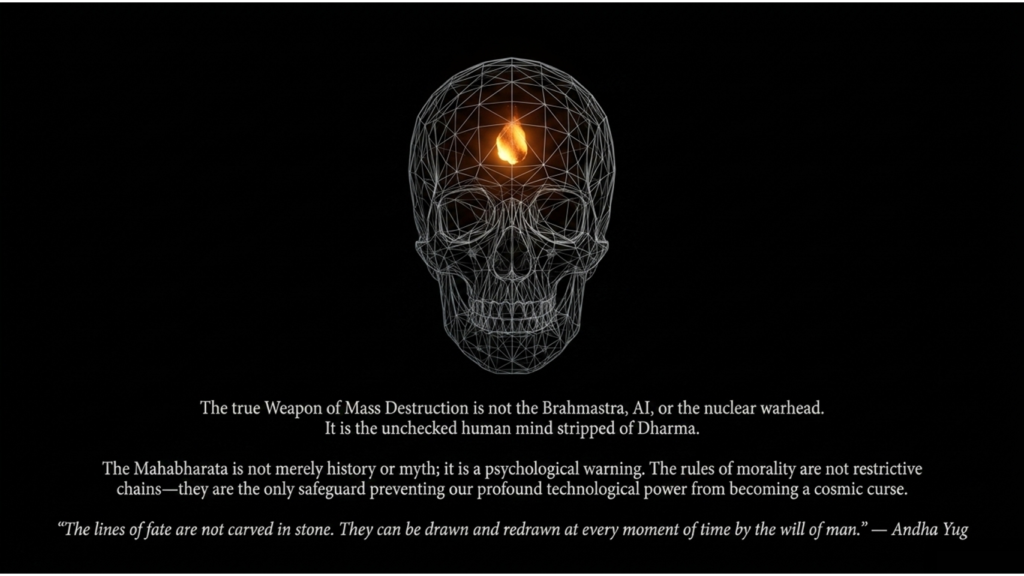
Strip away the celestial weaponry, the four heads of Brahma, the twelve years of drought — and the Mahabharata is making a claim that has nothing to do with technology at all:
The true weapon of mass destruction was never the Brahmastra, artificial intelligence, or a nuclear warhead. It is the unchecked human mind, stripped of dharma.
Read this way, the epic isn’t really a history or a myth — it’s a psychological warning. The rules of morality it spends eighteen books building and breaking aren’t restrictive chains. They’re the only safeguard standing between profound power and cosmic catastrophe. Every step on that escalation staircase — Bhishma, Drona, Karna, Duryodhana — was a small, seemingly justified exception. Ashwatthama’s night raid was simply the final one, taken to its absolute end.
“The lines of fate are not carved in stone. They can be drawn and redrawn at every moment of time by the will of man.”— Andha Yug
Three thousand years later, that’s still the part of the story that refuses to stay ancient.
📢 Affiliate Disclaimer: This article contains affiliate links. If you purchase through our links, we may earn a small commission at no extra cost to you. We only recommend products we’ve genuinely reviewed and believe offer real value to Indian buyers.
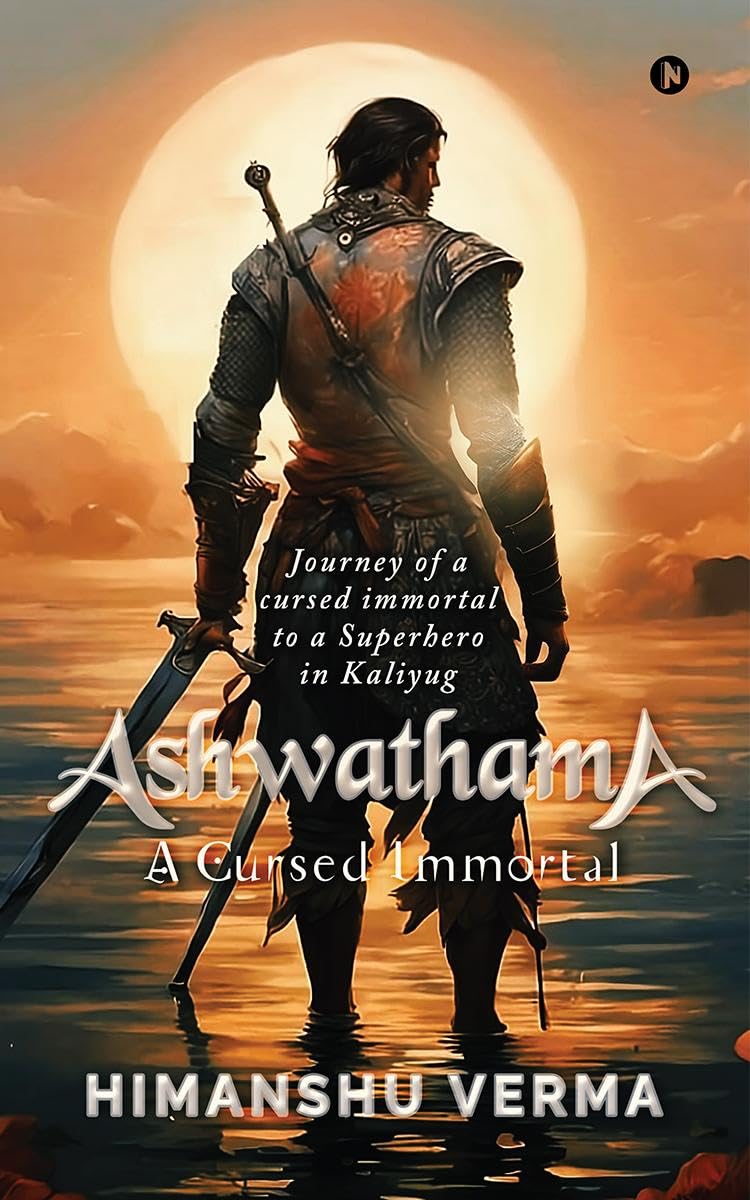
Ashwathama
1 thought on “Was the Brahmastra a Nuclear Weapon? Inside Ashwatthama’s Curse and the Mahabharata’s Doomsday Myth”